

Table of Contents
- What Red Light Therapy Actually Does to Your Skin
- Red Light Therapy for Collagen Production and Anti-Aging
- Skin Conditions That Respond to Red Light Therapy
- Device Specifications: Wavelengths, Irradiance, and What to Look For
- How Often to Use Red Light Therapy for Face Results
- Red Light Therapy Side Effects and Contraindications
- Frequently Asked Questions
Last Updated: August 31, 2026
What Red Light Therapy Actually Does to Your Skin
Red light therapy is a non-invasive treatment that exposes skin to low-level wavelengths of red and near-infrared light, typically between 630 and 850 nanometers, to stimulate biological processes at the cellular level. Unlike UV light, which damages skin tissue, red and near-infrared wavelengths penetrate the epidermis and reach the dermis without causing harm. This process is also called photobiomodulation, describing how specific light frequencies alter cellular behavior without heat or mechanical force.
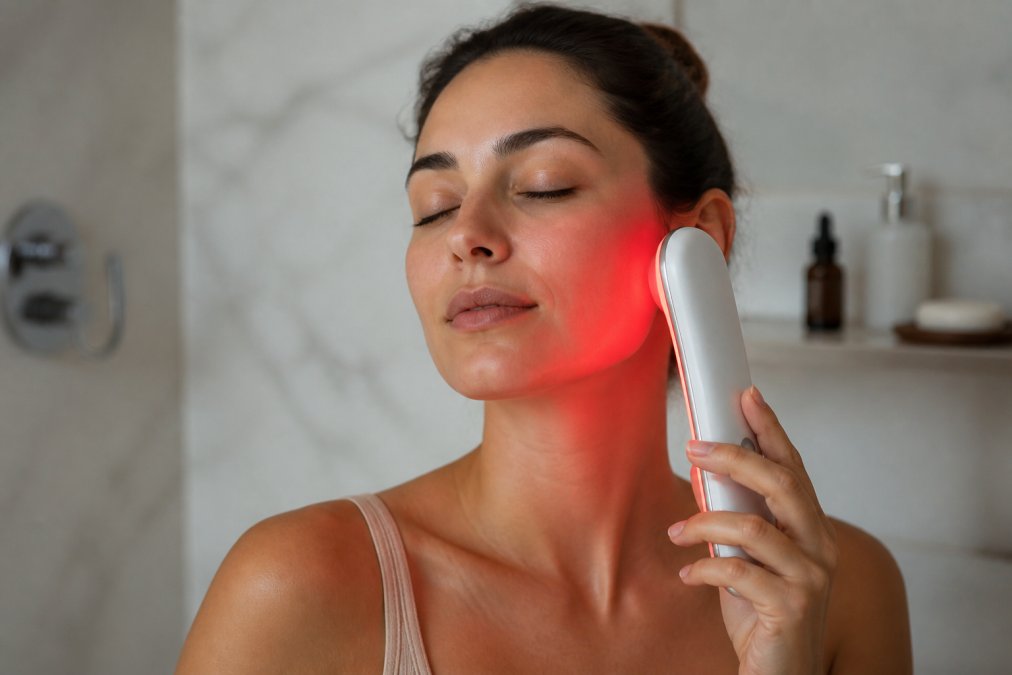
The Role of Mitochondria and ATP Production
Red light wavelengths are absorbed by chromophores inside the mitochondria, the energy-producing structures within skin cells. This absorption triggers an increase in adenosine triphosphate, or ATP, production, the primary fuel cells use for repair, regeneration, and synthesis.
When cellular energy rises, fibroblasts become more active. Fibroblasts are the cells in the dermis responsible for producing collagen and elastin, the structural proteins that give skin its firmness and elasticity. More ATP also reduces oxidative stress within the cell, a key driver of premature aging and inflammation. As documented in peer-reviewed photobiomodulation research published in the National Library of Medicine, low-level light therapy consistently demonstrates measurable effects on mitochondrial function and ATP synthesis in controlled laboratory conditions.
Red Light Therapy for Collagen Production and Anti-Aging
Collagen production is the headline benefit of red light therapy for skin. Collagen synthesis declines naturally with age, measurably so after the mid-twenties, and that decline accelerates with cumulative UV exposure, pollution, and chronic inflammation. Red light therapy addresses the upstream cause rather than masking the downstream symptom.
How Collagen Remodeling Actually Works Under Red Light
When red wavelengths, particularly in the 630-660nm range, are absorbed by cytochrome c oxidase in the mitochondrial membrane, the resulting increase in ATP output upregulates fibroblast proliferation and migration. Those activated fibroblasts synthesize new Type I and Type III collagen, the two structural subtypes most responsible for skin firmness.
Equally important is what red light therapy does to matrix metalloproteinases, or MMPs. MMPs are enzymes that break down existing collagen as part of normal tissue turnover. Chronic inflammation and UV exposure push MMP activity into overdrive, accelerating net collagen loss. Photobiomodulation modulates MMP expression downward while simultaneously increasing collagen synthesis, a two-sided effect that topical retinoids also pursue, but through a different pathway. This dual action is why anti-aging results from consistent red light therapy tend to be progressive rather than plateau-limited.
Fine Lines, Wrinkles, and Skin Elasticity
The fibroblast activation triggered by photobiomodulation leads to measurable increases in collagen and elastin production within the dermis. Over a consistent treatment period, this translates to improved skin elasticity and visible reduction in fine lines and wrinkles. According to clinical research on red light therapy and skin rejuvenation indexed by the American Academy of Dermatology, patients undergoing regular photobiomodulation sessions reported improvements in skin texture and reduced wrinkle depth without significant adverse effects.
Consistent treatment is key. A single session produces temporary improvement in circulation and skin tone, but lasting collagen remodeling requires repeated exposure over weeks.
The Clinical-to-Consumer Gap: What Studies Actually Measure
Clinical studies demonstrating meaningful collagen remodeling use professional-grade devices delivering irradiance levels of 50-200 mW/cm² at the skin surface, with precisely controlled wavelengths and session durations. Many consumer devices emit irradiance well below this threshold, sometimes below 20 mW/cm², meaning the fluence, or total energy dose, delivered per session is a fraction of what research protocols used.
Home devices can produce results proportional to their actual output. A device delivering 30 mW/cm² requires roughly three times the session duration of a device delivering 90 mW/cm² to accumulate the same fluence. If a device does not publish its irradiance at a specified treatment distance, that omission is itself informative.
Hyperpigmentation and Dark Spots
Red light therapy's anti-inflammatory properties reduce the chronic low-grade inflammation that drives melanin overproduction, the underlying cause of many forms of hyperpigmentation and dark spots. By calming inflammatory signaling in the dermis, red light therapy can gradually reduce uneven skin tone.
Red light therapy is not a bleaching agent and does not target melanin directly. It addresses the cellular environment that produces excess pigmentation. For post-inflammatory hyperpigmentation, the kind that follows acne or minor injury, this mechanism is particularly relevant.
Phototype Considerations
Individuals with deeper skin tones, Fitzpatrick types IV through VI, have higher melanin density in the epidermis, which absorbs some incident red light before it reaches target fibroblasts in the dermis. This does not make red light therapy ineffective for darker skin; it means adequate irradiance and session duration matter even more. Visible collagen remodeling may take longer to register against a higher-melanin baseline.
Skin Conditions That Respond to Red Light Therapy
The conditions with the strongest clinical evidence share one common factor: they all involve chronic inflammation, impaired tissue repair, or dysregulated cell turnover.
Acne and Inflammation
Red light at 630-660nm reduces pro-inflammatory cytokines, specifically interleukin-1 beta and tumor necrosis factor-alpha, in the skin, shortening the active inflammation phase of a breakout. This matters because tissue damage causing post-acne scarring and hyperpigmentation is driven largely by the inflammatory cascade, not by bacteria themselves.
Many practitioners combine red light with blue light (typically 415nm), which has direct antibacterial effects on Cutibacterium acnes. Red light alone is better suited to inflammatory acne and post-acne redness than to active bacterial breakouts.
Psoriasis: Managing Flares, Not Curing Disease
Psoriasis involves accelerated, dysregulated keratinocyte turnover in the epidermis. The anti-inflammatory effects of photobiomodulation, particularly its ability to modulate T-cell activity and reduce pro-inflammatory cytokine signaling that drives keratinocyte hyperproliferation, have shown genuine promise in managing flare severity.
Red light therapy does not alter the underlying autoimmune mechanism of psoriasis. What it can do, used consistently, is reduce plaque thickness, erythema, and scaling during active periods, and potentially extend intervals between flares. Most practitioners find near-infrared wavelengths in the 810-850nm range useful for reaching deeper dermal inflammation in thicker plaques.
Rosacea: Subtype Matters
Rosacea is not a single condition, it presents across four recognized subtypes, and red light therapy's relevance differs meaningfully between them.
- Erythematotelangiectatic rosacea (ETR): Characterized by persistent central facial redness and visible blood vessels. Red light's ability to calm vascular inflammation makes it a reasonable adjunct.
- Papulopustular rosacea: Involves inflammatory papules and pustules. The anti-inflammatory mechanism is relevant.
- Phymatous rosacea: Involves skin thickening and tissue overgrowth. Red light therapy has limited evidence for this subtype.
- Ocular rosacea: Affects the eyes and eyelids. Red light therapy near the eye area requires careful eye protection.
For ETR and papulopustular subtypes, most practitioners use shorter, more frequent sessions, often 10 minutes daily or five times weekly.
Wound Healing and Tissue Repair: The Strongest Evidence Base
Wound healing is perhaps the most well-documented application of red light therapy. The mechanism is multifactorial: increased ATP production accelerates fibroblast migration to the wound site, promotes angiogenesis, reduces local inflammation, and modulates the balance between collagen synthesis and MMP-driven degradation in a way that reduces hypertrophic scarring. As outlined in wound healing and photobiomodulation research from Harvard Medical School, the therapeutic effects on tissue repair are among the most consistently replicated findings in low-level light therapy research.
For practical skincare applications, this translates most directly to post-procedure recovery after chemical peels, microneedling, or laser resurfacing, where red light therapy can accelerate barrier restoration and reduce post-inflammatory erythema duration; post-acne scarring, where the collagen-remodeling mechanism applies to atrophic scars over three to six months of consistent use; and minor cuts and abrasions, where red light therapy can reduce the appearance of resulting marks by supporting organized collagen deposition.
Device Specifications: Wavelengths, Irradiance, and What to Look For
The difference between a device that produces clinical-grade results and one that produces nothing is almost entirely a function of specifications.
Wavelength determines which biological targets the light reaches. The two ranges with the strongest evidence are 630-660nm (red light), which targets the epidermis and upper dermis for surface-level skin rejuvenation and collagen synthesis, and 810-850nm (near-infrared), which penetrates deeper into the dermis for deeper inflammation and tissue support.
Irradiance, measured in milliwatts per square centimeter (mW/cm²), determines how much light energy actually reaches the tissue. A device with low irradiance requires longer sessions to deliver the same fluence, or total energy dose. Many consumer devices underperform because they emit insufficient irradiance to produce meaningful photobiomodulation at the recommended treatment distance.
| Specification | Optimal Range | Why It Matters |
|---|---|---|
| Red wavelength | 630-660nm | Targets collagen synthesis and surface skin |
| Near-infrared wavelength | 810-850nm | Reaches deeper dermis and tissue |
| Irradiance | 50-100+ mW/cm² | Determines effective treatment dose |
| Treatment distance | 6-12 inches | Affects delivered irradiance at skin surface |
| Session duration | 10-20 minutes | Required for adequate fluence accumulation |
A device that does not publish its irradiance specifications is a device you should not buy.
How Often to Use Red Light Therapy for Face Results
For general skin rejuvenation and anti-aging, a starting protocol of four to five sessions per week for the first four to six weeks is appropriate. This loading phase builds the cumulative cellular response that drives collagen remodeling. After that, a maintenance protocol of two to three sessions per week sustains results.
For inflammatory conditions like acne or rosacea, daily sessions during flare periods are common, tapering to three times weekly as the skin stabilizes. Consistency over intensity matters most, longer individual sessions do not compensate for infrequent use.
Realistic Expectations vs. Marketing Hype
Red light therapy is not a replacement for sunscreen, a consistent skincare routine, or dermatological treatment for serious skin conditions. It is a tool that, used correctly, accelerates the skin's own repair processes.
Realistic timeline for visible results: 2-4 weeks shows improved skin tone and reduced redness; 6-8 weeks brings noticeable reduction in fine lines and improved elasticity; 3-6 months delivers meaningful collagen remodeling and sustained improvement in skin texture and firmness.
Anyone promising dramatic results in a week is selling you something other than science.
Red Light Therapy Side Effects and Contraindications
The safety profile of red light therapy is one of its genuine strengths. For most people, properly administered photobiomodulation produces no significant adverse effects. Some users experience mild, temporary erythema immediately after treatment, which resolves within an hour. Eye sensitivity is a real concern; always use appropriate eye protection or keep eyes closed during facial treatments.
The contraindications that do exist are specific: active cancer or photosensitive conditions like lupus erythematosus; direct application over the thyroid gland; pregnancy, where insufficient evidence exists to confirm safety; and medications that cause photosensitivity, such as certain antibiotics, retinoids, and psychiatric medications.
Contraindications with Skincare Actives
Retinoids and retinol: Using high-strength retinoids immediately before or after a red light session can increase skin sensitivity and irritation. Separate retinoid application and red light therapy by several hours, or use retinoids in the evening and red light in the morning.
Exfoliating acids (AHAs, BHAs): Freshly exfoliated skin has a compromised barrier and is more reactive. Avoid using strong acids immediately before a red light session.
Photosensitizing serums: Some vitamin C formulations and certain botanical extracts can increase photosensitivity. Check the formulation of any active serum before layering it with red light treatment.
What works well together: Hyaluronic acid, peptide serums, and ceramide-based moisturizers are all compatible with red light therapy and may enhance results by supporting the skin barrier during the repair process. Use red light therapy on clean, product-free skin and apply serums and moisturizers afterward.
Frequently Asked Questions
What is the downside of red light therapy?
Red light therapy has a strong safety profile, but it is not without limits. Overuse can cause temporary skin irritation, redness, or dryness. People with photosensitivity conditions or those taking medications that increase light sensitivity should consult a dermatologist before starting. It also requires consistent, long-term use to maintain results, skipping sessions slows progress. The benefits of red light therapy for skin are real, but they are gradual, not instant.
Can I use red light on my face every day?
Daily use is generally considered safe for most people, and many clinical protocols recommend sessions three to five times per week for the first four to eight weeks. After that, a maintenance schedule of two to three sessions per week is typical. The key variable is session length, most at-home devices recommend five to twenty minutes per area. Exceeding recommended durations does not accelerate results and may cause mild erythema or irritation.
How long does it take for red light therapy to tighten skin?
Skin tightening results from increased collagen synthesis, which takes time. Most users notice improved skin texture and tone within four to six weeks of consistent use. More visible tightening and reduction in fine lines typically appears between eight and twelve weeks. Results vary based on device irradiance, wavelength, session frequency, age, and baseline skin condition. Treating red light therapy as a long-term skin investment, rather than a quick fix, produces the most reliable outcomes.
Is red light therapy FDA-cleared for home use?
Yes. The FDA has cleared several at-home red light therapy devices as non-significant risk devices for cosmetic and dermatological use, including for skin rejuvenation and acne treatment. FDA clearance means the device has been reviewed for safety and basic efficacy claims. It does not mean every device on the market is cleared, so checking a specific device's FDA status before purchasing is worth doing, particularly for devices making therapeutic claims.
The benefits of red light therapy for skin are real, clinically documented, and accessible through at-home devices when the right specifications are met. The challenge most people face is cutting through the noise to find devices and protocols that actually deliver. TresAdore curates red light therapy tools selected for their clinical-grade specifications and genuine efficacy, not for their packaging. Explore The Collection and find the device that fits your skin goals and your routine.


