

Table of Contents
- What Defines High Quality Jewelry?
- Your Jewelry Hallmark Guide: Reading Metal Purity Stamps
- How to Tell if Gold is Real: Simple Home Tests
- Fine Jewelry vs Fashion Jewelry: Which Should You Buy?
- Evaluating Gemstones and Craftsmanship Quality
- How to Buy High Quality Jewelry Online Safely
- Common Mistakes to Avoid When Buying Jewelry
- Conclusion: Invest in Pieces That Last
- Frequently Asked Questions
Last Updated: September 4, 2026
What Defines High Quality Jewelry?
High quality jewelry is defined by the integrity of its materials, the security of its construction, and the transparency of its origins, not merely by its price tag. The difference between a piece that lasts decades and one that tarnishes in months comes down to verifiable markers like metal purity stamps and solid gemstones.
The 5 C's of Jewelry Evaluation
Beyond the traditional diamond 4 C's, evaluating a complete piece requires a broader framework: Carat (weight of metal and stones), Color (of gold or the gemstone's hue), Clarity (of any stones), Cut (the stone's proportions), and Craftsmanship (build quality). While the first four determine material value, craftsmanship is the true determinant of longevity.
Your Jewelry Hallmark Guide: Reading Metal Purity Stamps
Learning to read hallmarks is the single most effective skill for identifying high quality jewelry, as these tiny stamps are a legal declaration of metal purity. In the United States, the Federal Trade Commission regulates these marks to ensure they are not misleading, making them a reliable first checkpoint (the FTC).
Here is what you will typically see stamped inside a band or on a clasp:
- 925: Indicates 92.5% pure sterling silver, alloyed with other metals for strength.
- 14k or 585: Indicates 14-karat gold, which is 58.5% pure gold mixed with alloys.
- 18k or 750: Indicates 18-karat gold, which is 75% pure gold, offering a richer color.
- Platinum or 950: Indicates 95% pure platinum, a dense, hypoallergenic precious metal.
If you see terms like "gold plated" or "gold filled" without a karat stamp, the piece has only a thin layer of gold over a base metal. For a piece to be considered fine jewelry, it should carry the karat stamp directly. The FTC Guides for the Jewelry Industry provide clear definitions for how these metals must be labeled to protect consumers from misrepresentation. A hallmark is your first line of defense against overpaying for base metal.

How to Tell if Gold is Real: Simple Home Tests
Before you commit to a purchase, a few non-destructive home tests can help you spot obvious fakes or gold-plated items passing as solid gold.
The magnet test is the easiest starting point: pure gold is not magnetic, so strong attraction indicates significant base metal. The ceramic test involves gently scraping the item against an unglazed ceramic plate; real gold leaves a yellow streak, while base metals leave a gray or black mark. Be cautious, as this test can cause minor surface scratches.
A more reliable visual check is the stamp test: if a piece claims to be 14k gold but lacks a stamp, treat it with suspicion. For a definitive answer, a jewelry appraisal from a certified gemologist is the gold standard, but for everyday vetting, combining the magnet test with a visible hallmark is usually sufficient.
Fine Jewelry vs Fashion Jewelry: Which Should You Buy?
The distinction between fine jewelry vs fashion jewelry comes down to material composition and longevity. Fine jewelry is crafted from precious metals like solid gold, sterling silver, or platinum and often features genuine gemstones. Fashion jewelry, also known as costume jewelry, uses base metals like brass or copper, often finished with gold plating or vermeil.

Your choice should depend on how you intend to wear the piece. For everyday wear pieces you will rarely remove, fine jewelry is the only sensible option because it resists tarnish and withstands daily friction. For trend-driven pieces meant for a single season, a high-quality fashion piece might suffice.
The economics favor fine jewelry over time. While the upfront cost is higher, a solid gold necklace does not need replacing every year, making it more cost-effective than buying a $30 plated necklace several times annually.
Evaluating Gemstones and Craftsmanship Quality
Assessing a gemstone's quality and the security of its setting requires a systematic approach. While beauty is subjective, structural integrity and optical performance are objective and verifiable.
The 4 C's Applied to Loose Gemstones
For diamonds, the Gemological Institute of America (GIA) established the universal standard (gia.edu). For colored gemstones, the same principles apply, but the priority order shifts:
- Cut: This is the most critical factor for brilliance. A well-cut stone has precise angles and proportions that allow light to enter, reflect off the internal facets, and return to your eye. A stone that is cut too deep or too shallow will 'leak' light and appear dull.
- Color: For white diamonds, the goal is colorlessness (graded D through Z). For colored stones like sapphires or rubies, the most valuable specimens have a vivid, saturated, and even color.
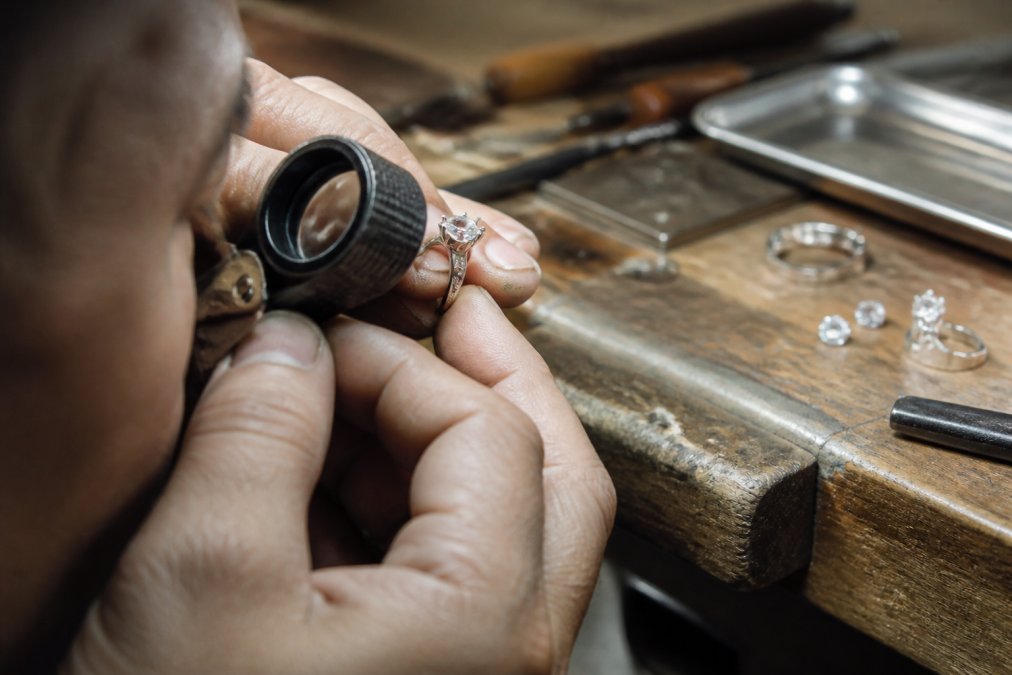
- Clarity: This refers to the absence of internal inclusions (called 'jardin' in emeralds) and surface blemishes. Use a 10x jeweler's loupe to inspect the stone. For most colored stones, minor inclusions are acceptable if they do not affect durability.
- Carat: This is simply the weight. However, be aware that two stones of equal carat weight can appear very different in size depending on their cut proportions.
The Setting: A Structural Inspection
A high-quality gemstone in a weak setting is a liability. Here is an inspection routine to assess craftsmanship:
- Check the Prongs: Each prong should be uniform in size and shape. They should be tightly pressed against the girdle of the stone, not loose or bent. Use your fingernail to gently see if the stone moves; it should not. Look at the tips of the prongs, they should be rounded and polished, not sharp or flat, which indicates they have worn down and may soon break.
- Examine the Gallery and Basket: If the setting is open, look at the metalwork underneath the stone. It should be smooth and free of rough solder joints or pits.
- Test the Clasp Mechanism: For bracelets and necklaces, the clasp is the most common point of failure. A spring-ring clasp is common but can be a weak point. A box clasp with a safety catch or a screw clasp is far more secure for valuable pieces.
- Look for Hallmarks of Quality: A well-made piece will have a smooth, polished interior. Rough edges or a 'sandpaper' feel on the inside of a band are signs of mass production and poor finishing.
The Role of Independent Certification
For diamonds over 0.5 carats and high-value colored stones, an independent grading report is non-negotiable. The most respected labs are the Gemological Institute of America (GIA) and the American Gem Society (AGS). These reports provide a detailed, unbiased analysis of the 4 C's and often include a plot of the stone's inclusions. A certificate from a less-known lab may not adhere to the same rigorous standards. If a seller cannot provide a report from a major lab for a high-value stone, treat this as a significant red flag.
How to Buy High Quality Jewelry Online Safely
Buying jewelry online eliminates the ability to physically inspect the piece, increasing the importance of rigorous pre-purchase verification. A successful purchase is about mitigating risk through a systematic review of the seller, the product listing, and the transaction terms.
Step 1: Vet the Seller's Credentials and Reputation
Before you even look at a product, investigate the seller. A reputable online jeweler should have a verifiable physical address and a customer service phone number. Check their profile on the Better Business Bureau (BBB) for unresolved complaints and look for independent reviews on third-party platforms like Trustpilot.
Step 2: Scrutinize the Product Listing for Specific Claims
The language in a product description is your first line of defense. High-quality listings are precise, stating the exact metal type and purity (e.g., "14k yellow gold" not "gold color"), the exact carat weight of any gemstones, and the specific type of setting. Be wary of these vague or misleading terms:
- "Gold Plated" or "Gold Filled": These are not fine jewelry. Gold plated has a microscopic layer of gold over a base metal. Gold filled has a thicker layer but is still a composite, not solid gold.
- "Gemstone" vs. "Synthetic Gemstone" vs. "Simulant": A genuine gemstone is natural. A synthetic gemstone has the same chemical composition as a natural one but is lab-created (e.g., a lab-created sapphire). A simulant is a different material that looks like the gemstone (e.g., cubic zirconia for a diamond). The price and value differ dramatically between these three.
- "Vintage" or "Antique": These terms have specific legal definitions in some contexts. A vintage piece is typically at least 20 years old, and an antique is at least 100 years old. If the listing uses these terms, they should be able to provide provenance.
Step 3: Demand High-Resolution, Unedited Photos and Video
Professional photos can hide flaws. Ask the seller for additional photos under natural light, showing the piece from multiple angles, including the clasp, hallmarks, and a close-up of the gemstone. For high-value items, request a short video of the piece being moved.
Step 4: Understand the Return Policy and Warranty Before You Pay
This is your most critical consumer protection. A reputable seller will offer a return window of at least 30 days, with clarity on who pays return shipping and whether there is a restocking fee. Crucially, the policy should allow you to have the item independently appraised during the return window; if the appraisal reveals the piece does not match the description, you should be able to return it for a full refund.
Step 5: Use Secure Payment Methods
Pay with a credit card, which offers the strongest consumer protections under the Fair Credit Billing Act. This allows you to dispute a charge if the item is not as described or never arrives. Avoid paying via wire transfer, cryptocurrency, or peer-to-peer payment apps.
Common Mistakes to Avoid When Buying Jewelry
The most common mistake is prioritizing carat weight or size over cut quality and setting security, resulting in a large but lifeless stone at risk of falling out. Another frequent error is ignoring the clasp; a beautiful bracelet is useless if the clasp fails after a week of wear.
Here are the critical pitfalls to sidestep:
- Assuming all "gold" is the same: Ignoring the karat stamp leads to overpaying for low-purity alloys.
- Skipping the hallmark check: Failing to verify metal purity on sterling silver or platinum items.
- Forgetting the return policy: Buying without a clear return window leaves you stuck with a poor-quality piece.
- Ignoring maintenance needs: Not asking about tarnish resistance or how to care for the specific metal.
- Prioritizing price over warranty: Choosing the cheapest option often means sacrificing the secure clasp and setting integrity.
A final mistake is neglecting jewelry maintenance. Even the best pieces require occasional cleaning and inspection to ensure prongs remain tight. Regarding ethical sourcing, many buyers now ask about conflict-free diamonds and sustainable metals; a transparent seller will gladly discuss their supply chain.
Conclusion: Invest in Pieces That Last
Choosing high quality jewelry comes down to shifting your mindset from buying disposable trends to acquiring lasting pieces that hold their value and withstand daily wear. By mastering the hallmark guide, understanding the fine vs fashion jewelry divide, and insisting on secure craftsmanship, you protect your investment and build a collection that reflects your standards.
This approach aligns with intentional living, where every purchase serves a purpose. Whether you are seeking a statement piece or an everyday essential, prioritize verification over impulse. Explore the curated selection at TresAdore to find pieces that meet these rigorous standards.
Finding jewelry that balances durability, beauty, and ethical production can feel overwhelming, but it does not have to be. TresAdore offers a hand-selected collection of fine jewelry and premium accessories that meet our exacting standards for quality and design. From sterling silver necklaces to automatic mechanical watches, every item is chosen to elevate your style and last for years. Explore The Collection and discover pieces that are genuinely worth owning.

Frequently Asked Questions
How can you tell if jewelry is high quality?
Look for clear hallmarks indicating metal purity, such as 925 for sterling silver or 14K for gold. Examine the craftsmanship: prongs should be even and secure, clasps should close firmly, and the piece should feel substantial for its size. High quality jewelry uses durable metals and genuine stones.
What is the difference between fine jewelry and fashion jewelry?
Fine jewelry uses precious metals like solid gold, platinum, or sterling silver and genuine gemstones, making it durable for everyday wear. Fashion jewelry uses base metals with gold plating or vermeil and synthetic stones, which costs less but is not built for long-term durability or resale value.
Is hallmark stamping a reliable indicator of jewelry quality?
Hallmarks are a strong starting point because they indicate the metal's purity, like 14K or 925. However, stamps can be faked on low-quality pieces, so pair hallmark checks with home tests. Inspect for tarnishing, and verify the stamp's placement and clarity to confirm the piece is genuinely high quality.
What should you look for when buying gold jewelry?
Check the karat stamp, which tells you the gold purity: 24K is pure, while 14K and 18K are alloyed for durability. For everyday wear, 14K offers a good balance of strength and value. Look for a secure clasp and smooth finish, and ask for certification if the piece includes precious gemstones.


