

Table of Contents
- Why Gold Jewelry Loses Its Luster
- Safe Household Items for Cleaning Gold
- Step-by-Step: How to Clean Gold Jewelry at Home
- How Often to Clean Gold Jewelry
- How to Store Gold Jewelry to Prevent Tarnishing
- When to Seek Professional Cleaning
- Daily Habits That Preserve Your Jewelry's Shine
- Conclusion: Make Luster Maintenance a Ritual
- Frequently Asked Questions
Last Updated: September 9, 2026
Why Gold Jewelry Loses Its Luster
Gold jewelry luster is the warm, reflective glow that makes fine pieces look alive against the skin. That brilliance fades for reasons that have nothing to do with the quality of your metal: everyday exposure to body oils, lotions, perfumes, and household products leaves a thin film on the surface that scatters light instead of reflecting it.
The science is straightforward: pure gold is chemically inert, but most jewelry is an alloy. A 14k piece contains roughly 58 percent gold mixed with silver, copper, and zinc, and those base metals react with oxygen and sulfur in the air, producing tarnish that many owners mistake for damage (science.org).
The good news is that luster loss is almost always reversible with the right techniques and a few household staples.
Safe Household Items for Cleaning Gold
You do not need commercial dips or fancy kits to clean most gold jewelry. The safest, most effective solution is warm water and mild dish soap: a few drops in a small bowl of lukewarm water creates a gentle degreaser that lifts accumulated oils without attacking the metal.
Keep these items on hand:
- Mild dish soap (free of dyes, citrus, and ammonia)
- Soft-bristled brush, such as a baby toothbrush
- Microfiber cloth for drying and buffing
- Small bowl lined with a towel to catch dropped pieces
What you should never use matters just as much. Avoid abrasive cleaners, toothpaste, baking soda pastes, and any product containing chlorine, which breaks down the metal structure itself. Skip paper towels and tissues, whose fine fibers leave micro-scratches that dull luster over time.
Why Your Gold's Alloy Dictates Its Care
Not all gold is the same; the metals mixed with it determine how aggressive you can be.
- Yellow gold (14k or 18k) is typically alloyed with silver and copper. These metals tarnish slowly, and standard soap-and-water cleaning is entirely safe. The main risk is physical scratching, not chemical damage.
- White gold is alloyed with nickel, palladium, or manganese, then coated with rhodium plating. That plating is what gives white gold its bright, mirror-like finish. Harsh scrubbing or abrasive pastes wear the rhodium away faster, exposing the slightly yellowish base metal underneath. Use only the softest brush and gentle pressure on white gold, and expect to have it re-plated every one to three years depending on wear.
- Rose gold gets its pink hue from a higher copper content, sometimes up to 25 percent in 14k pieces. Copper is more reactive than silver or zinc, which means rose gold can develop a subtle darkening or patina faster than yellow gold. This is not damage; it is oxidation of the copper. A gentle soap-and-water soak removes the film, but avoid acidic cleaners like lemon juice or vinegar, which can strip the surface unevenly and leave a blotchy appearance.
The Chlorine Myth That Damages Jewelry
A common misconception is that a quick dip in a chlorinated pool is harmless if you rinse afterward. In reality, chlorine reacts with the alloy metals in gold jewelry, not the pure gold itself. The reaction is cumulative: each exposure weakens the molecular structure of the copper or silver, making prongs more brittle and prone to snapping. This is why jewelers consistently report that rings worn while swimming come in with bent or broken settings far more often than rings that never touch pool water. Rinsing after exposure helps remove surface residue, but it cannot reverse the structural weakening that has already begun.
What About Commercial Jewelry Cleaners?
Store-bought dips and foams are not inherently harmful, but they are unnecessary for routine care. Most contain ammonia or mild detergents that work faster than dish soap but offer no additional benefit for lightly soiled pieces. The risk is overuse: ammonia-based dips can strip the rhodium layer on white gold and are never safe for porous stones like pearls, opals, or turquoise. If you do use one, check the label for ammonia and limit use to once a month on plain yellow gold without stones.
The Eco-Friendly Alternative
For environmentally conscious owners, a simple castile soap solution works as effectively as commercial degreasers. Mix one teaspoon of liquid castile soap (olive-oil based, biodegradable, and free of synthetic fragrances) into lukewarm water, then soak and brush as you would with dish soap. It lifts oils without leaving residue and is safe for septic systems. Avoid "natural" cleaners with citrus oils or vinegar, as acidity can dull high-polish finishes.
Step-by-Step: How to Clean Gold Jewelry at Home
A proper home cleaning takes about five minutes. Follow this sequence every time:
- Fill a small bowl with lukewarm water and add two or three drops of mild dish soap.
- Soak your piece for five to ten minutes to loosen surface oils and residue.
- Gently brush the piece with the soft-bristled brush, paying attention to crevices and settings where dirt collects.
- Rinse thoroughly under warm running water, placing a strainer or stopper in the sink to prevent loss.
- Pat dry with a microfiber cloth, then buff gently to restore shine.
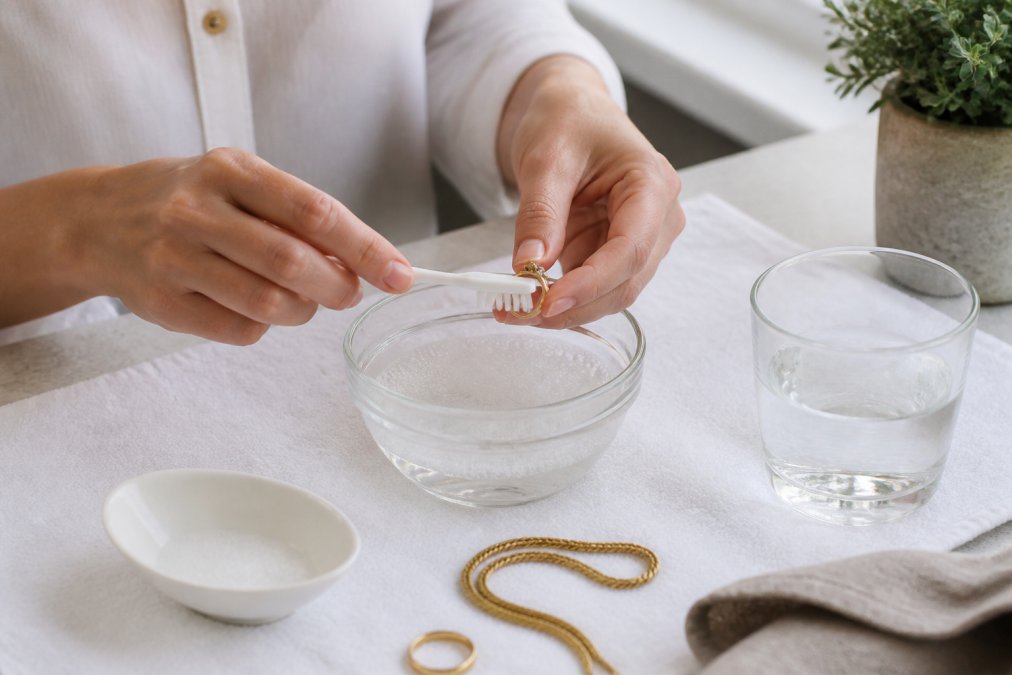
One caution: this method works for plain gold bands and most pendants, but gemstone settings require more care. Pearls, opals, and emeralds are porous and can be damaged by soaking. For those pieces, use a damp cloth to wipe the surface only, and avoid submerging them entirely.
How Often to Clean Gold Jewelry
Most pieces benefit from a thorough cleaning every two to four weeks. Rings worn daily, especially engagement rings and wedding bands, accumulate hand creams and soap residue faster than occasional pieces.
If the piece looks dull when held to the light, it is time to clean it. Daily wearers may need weekly attention, while pieces worn a few times a month can go six to eight weeks. Earrings and delicate chains, which touch less oil-rich skin, sit at the longer end of that range.
For high-polish pieces, the frequency question ties directly to how to maintain gold jewelry luster long-term: consistent, gentle cleaning beats occasional deep scrubbing every time. A quick rinse and pat dry after heavy wear, such as a sweaty workout or a day at the beach, prevents buildup before it starts.
How to Store Gold Jewelry to Prevent Tarnishing
Proper storage is the single most effective way to slow tarnish and preserve gold jewelry luster between wears. The enemy is not air itself but humidity, sulfur compounds, and physical contact with harder metals.
Store each piece individually in a soft pouch or compartmentalized jewelry box. When gold rubs against other pieces, harder stones can scratch softer metal, and chains can knot into permanent tangles. Add a small silica gel packet to your jewelry box to absorb ambient moisture, which accelerates oxidation.
Air-tight options work best for pieces you wear rarely. Resealable plastic bags with the air pressed out, or anti-tarnish strips placed inside a closed box, create a low-oxygen environment that dramatically slows dulling. The Gemological Institute of America's jewelry care guidance recommends storing pieces away from direct sunlight and temperature swings, both of which can stress prongs and affect certain gemstones.
When to Seek Professional Cleaning
Home care handles routine buildup, but some situations call for a jeweler's expertise. Intricate filigree, dense pave settings, or a matte finish you want preserved require professional equipment.
Professional jewelers use ultrasonic cleaners and steamers that reach crevices a brush cannot. These machines are highly effective for plain gold and diamond pieces, but not every stone can tolerate them. If you notice loose prongs, a bent clasp, or visible thinning of the metal, take the piece in before cleaning it yourself, as these issues require repair.
A professional inspection once a year is a smart habit. Jewelers can check prong tightness, re-polish scratched surfaces, and restore a factory-level finish that home buffing cannot replicate. This is preventative care that protects your investment and catches small problems before they become expensive ones.
Home Ultrasonic Machines: The Hidden Risks
Consumer-grade ultrasonic cleaners are widely available online for under $50, and their appeal is obvious: drop in a ring, press a button, and walk away. But the gap between home and professional machines is not just price; it is frequency, power control, and heat management.
Professional units operate at carefully calibrated frequencies (typically 40-50 kHz) with temperature controls that prevent thermal stress. Home units often run at inconsistent frequencies and lack temperature regulation. The vibrations that dislodge dirt also loosen stones if the piece has pre-existing weakness in its prongs. A jeweler inspects each piece before cleaning and skips ultrasonic treatment for stones that are fragile, oiled, or fracture-filled; a home user rarely knows which of their stones fall into those categories.
Another overlooked risk is solution contamination. Ultrasonic cleaners work by creating microscopic bubbles that implode and pull dirt away from the metal. If the solution is not changed regularly, those bubbles redeposit abrasive particles onto your jewelry at high velocity, effectively sandblasting the surface. Professional jewelers use fresh, filtered solutions for each batch; home users often reuse the same water for weeks.
Steam Cleaning: The Professional Standard
Professional jewelers prefer steam cleaning for final finishing because it leaves zero chemical residue. Steam cleaners heat distilled water to over 200°F and direct a high-pressure jet at the piece, blasting away any film that ultrasonic cleaning loosened. The heat also dries the piece instantly.
Steam cleaning is not something to attempt at home. Consumer steam cleaners do not reach the pressure or temperature of jeweler-grade units, and directing hot steam at a piece with a loose stone can shock the setting. Leave this step to the professionals.
What a Professional Cleaning Actually Costs
A standard professional cleaning and inspection at a local jeweler typically runs between $25 and $60 for a single piece, and many jewelers offer it free for pieces purchased in their store. This usually includes ultrasonic cleaning, steam finishing, and a visual inspection of prongs and clasps under magnification. Re-polishing is a separate service, typically starting around $40. Rhodium re-plating for white gold adds another $50 to $90 depending on surface area.
The Decision Framework
Use this simple test to decide between home care and professional service:
- Home cleaning is sufficient if the piece is plain gold without stones, shows only surface film, and has no visible damage.
- Professional cleaning is recommended if the piece has gemstones you cannot identify with certainty, intricate settings with tight crevices, or a finish (matte, hammered, or brushed) that you want preserved exactly.
- Skip cleaning entirely and go straight to repair if you notice a loose stone, a bent prong, a cracked shank, or any visible thinning of the metal. Cleaning a damaged piece can worsen the problem.
Daily Habits That Preserve Your Jewelry's Shine
The habits that keep your gold looking new are mostly about timing. Put jewelry on last, after hairspray, perfume, and lotion have dried, as those products contain alcohol and oils that accelerate film buildup.
Remove your rings before washing hands, swimming, or cleaning with household chemicals. Repeated chlorine exposure, whether from pools or cleaning products, weakens gold alloys over time and can cause prongs to become brittle. Consumer Reports' guidance on jewelry care echoes this warning, noting that even brief contact with harsh chemicals can dull finishes that require professional buffing to restore.
Develop a simple end-of-day ritual: wipe each piece with a microfiber cloth before returning it to its storage spot. This thirty-second habit removes the day's oils and prevents them from setting into a stubborn film. For white gold, gentle care extends the rhodium plating's life.
Conclusion: Make Luster Maintenance a Ritual
Caring for your jewelry is an extension of the intentionality you bring to wearing it. A few minutes of gentle cleaning every few weeks, smart storage, and mindful daily habits will keep your pieces radiant for decades.
At TresAdore, we believe the pieces you wear should reflect your care and attention. Our curated fine jewelry collection is selected for quality that rewards proper maintenance, and we encourage you to treat each piece as an heirloom in the making.
Frequently Asked Questions
How do I make my gold jewelry shiny again?
Mix a few drops of mild dish soap into a bowl of warm water. Soak your gold jewelry for 10-15 minutes, then gently scrub with a soft-bristled brush. Rinse under warm water and pat dry with a microfiber cloth. This removes accumulated oils and residue that dull the surface. For stubborn tarnish, add a drop of ammonia to the solution, but avoid this on pieces with gemstone settings.
Can I use dish soap to clean gold jewelry?
Yes, mild dish soap is one of the safest household items for cleaning gold. It cuts through accumulated oils and daily grime without damaging the metal. Use a few drops in warm water and avoid citrus-based or abrasive formulas. Always rinse thoroughly and pat dry with a soft cloth to prevent soap residue from dulling the luster of your gold jewelry.
Why is my gold not shiny anymore?
Gold jewelry loses its shine due to a buildup of oils, lotions, and dust that creates a film over the surface. Pure gold does not tarnish, but most jewelry is made from alloys like 14k or 18k gold. The other metals in these alloys, especially copper, react with oxygen and sulfur in the air, causing oxidation. Regular gentle cleaning removes that layer and restores the original brilliance.
How often should gold jewelry be professionally cleaned?
Schedule a professional cleaning once or twice a year, depending on how often you wear your pieces. Professional jewelers use ultrasonic cleaners and steamers that remove deep-set residue from crevices and prong settings. They also inspect for loose stones or worn prongs. Between visits, maintain gold jewelry luster with weekly at-home cleaning using mild dish soap and a soft brush.
Gold luster maintenance comes down to consistency, not complexity. By adopting the gentle cleaning routine and storage habits outlined here, you protect the beauty and longevity of every piece you own. Explore the TresAdore collection to find jewelry crafted for a lifetime of shine, and let your care ritual match the quality of what you wear.


