

Table of Contents
- How Red Light Therapy Works at the Cellular Level
- Understanding Wavelengths and Light Penetration
- Benefits of Red Light Therapy for Skin
- How Long Should You Use Red Light Therapy?
- Red Light Therapy Side Effects and Safety Profile
- Comparing LED, Laser, and Infrared Devices
- Frequently Asked Questions
Last Updated: September 16, 2026
How Red Light Therapy Works at the Cellular Level
Red light therapy is the use of specific wavelengths of red and near-infrared light to stimulate cellular repair, reduce inflammation, and support tissue healing. The science behind red light therapy centers on how light energy interacts with the mitochondria inside your cells.
The concept dates back to research NASA conducted on plant growth and wound healing in space. Today, that same principle powers devices you can use at home.
Mitochondria, ATP, and Cytochrome C Oxidase
Mitochondria are the power plants of your cells. They produce adenosine triphosphate (ATP), the molecule your body uses for energy. When red and near-infrared light reaches your cells, it interacts with a protein called cytochrome c oxidase inside the mitochondria.
This interaction triggers a chain of events: increased ATP production, reduced oxidative stress, and activation of transcription factors that support tissue repair. The process is called photobiomodulation.
What most guides miss is that light doesn't force a reaction. It gives your cells the raw material to do what they already do, only more efficiently.
Understanding Wavelengths and Light Penetration
Wavelength is the single most important specification to check before buying any red light therapy device. It determines how deep the light penetrates, which chromophores absorb it, and which tissues respond. Two devices can look identical and produce completely different biological effects if their wavelengths differ by even 20 nanometers.
The Therapeutic Window: 600-1,100 nm
Photobiomodulation works within a narrow band of the electromagnetic spectrum, roughly 600 to 1,100 nanometers. This range is often called the "optical window" because it is where skin, blood, and water absorb the least light, allowing photons to reach deeper tissue.
- Red light (630-660 nm) reaches the dermal layers of your skin, supporting collagen synthesis, fibroblast activity, and skin rejuvenation.
- Near-infrared light (810-850 nm) penetrates deeper into muscle, joint, and nerve tissue, which is why it is used for pain relief, recovery, and wound healing.
- Far-infrared (above ~3,000 nm) is a different mechanism entirely. It delivers heat, not photobiomodulation, and does not interact with cytochrome c oxidase.
Below 600 nm, hemoglobin and melanin absorb most of the light before it reaches target tissue. Above roughly 1,100 nm, water absorption dominates and the energy converts to heat rather than cellular signaling.
Irradiance, Dose, and the J/cm² Formula
This is where most guides stop short, and where buyers get confused. Wavelength tells you what the light does. Dose tells you how much you actually delivered.
The clinical unit for dose is joules per square centimeter (J/cm²). You calculate it with a simple formula:
Dose (J/cm²) = Irradiance (mW/cm²) × Time (seconds) ÷ 1,000
Irradiance, also called power density, is how much light energy hits each square centimeter of skin per second. It is measured in milliwatts per square centimeter (mW/cm²). A device rated at 50 mW/cm² run for 10 minutes (600 seconds) delivers:
50 × 600 ÷ 1,000 = 30 J/cm²
Most published clinical protocols for skin and pain fall somewhere between 1 and 60 J/cm² per session, with the sweet spot for many conditions around 4-10 J/cm².
The Biphasic Dose Response (Arndt-Schulz Curve)
More time is not better. Photobiomodulation follows a biphasic dose response, sometimes called the Arndt-Schulz curve: low doses stimulate cellular activity, moderate doses produce the strongest response, and high doses suppress or reverse the benefit.
What to Check on a Spec Sheet
- Wavelength(s) listed in nm, not just "red" or "infrared."
- Irradiance in mW/cm² at a stated distance (irradiance drops sharply as you move away from the panel).
- Treatment area, a small wand and a full-body mat deliver very different total energy even at the same irradiance.
- Whether the rating is per-LED or total output, these are not the same number, and marketing often blurs the distinction.
A device that lists only "660nm red light" without irradiance is a starting point, not a full specification. The dose is what your cells actually respond to.
Benefits of Red Light Therapy for Skin
The most well-documented benefits of red light therapy for skin include improved collagen production, reduced fine lines, and faster wound healing. Red light at 630-660nm stimulates fibroblasts, the cells responsible for producing collagen and elastin.
How Long Should You Use Red Light Therapy?
Most at-home devices recommend 10-20 minutes per session, three to five times per week. The precise duration depends on the device's irradiance (power output) and the condition you're addressing.
| Goal | Session Length | Frequency | Notes |
|---|---|---|---|
| Facial skin rejuvenation | 10-15 minutes | 4-5x weekly | Use a dedicated mask or panel |
| Muscle recovery | 15-20 minutes | 3-4x weekly | Full-body mats work well |
| Localized pain relief | 10-15 minutes | Daily if needed | Target the specific area |
Red Light Therapy Side Effects and Safety Profile
Red light therapy side effects are rare and typically mild. The most common complaints are temporary redness, mild warmth at the treatment site, and occasional headache from prolonged sessions.
Comparing LED, Laser, and Infrared Devices
The word "light therapy" covers at least four distinct device categories, and they are not interchangeable. Understanding the differences helps you tell legitimate photobiomodulation from marketing hype.
LED Panels and Masks
LED devices use multiple light-emitting diodes to cover a broad area. They are the most common option for home use because they are affordable, safe without professional supervision, and effective for skin and surface-level tissue.
Lasers and Clinical Devices
Laser devices concentrate a single wavelength into a narrow, coherent beam. Clinical lasers can deliver much higher irradiance, often several hundred mW/cm² or more, which means shorter sessions and deeper penetration.
Near-Infrared vs. Far-Infrared: Not the Same Therapy
This is the most common point of confusion. "Infrared" alone tells you nothing about the mechanism.
- Near-infrared (NIR, ~800-1,100 nm) is invisible light that penetrates tissue and triggers photobiomodulation via cytochrome c oxidase, the same mechanism as red light, just deeper.
- Far-infrared (FIR, above ~3,000 nm) is radiant heat. It warms tissue, promotes circulation, and can feel relaxing, but it does not drive ATP production or collagen synthesis through the photobiomodulation pathway.
Quick Comparison
| Category | Wavelength | Coherence | Typical Home Use | Primary Mechanism |
|---|---|---|---|---|
| Red LED | 630-660 nm | Non-coherent | Masks, panels | Photobiomodulation (skin) |
| Near-infrared LED | 810-850 nm | Non-coherent | Panels, mats, belts | Photobiomodulation (deep tissue) |
| Laser | Single nm | Coherent | Clinical, some home caps | Photobiomodulation (high dose) |
| Far-infrared | >3,000 nm | N/A | Saunas, heating pads | Thermal / circulatory |
Matching the Device to the Goal
- Facial skin, fine lines, acne: a red LED mask or panel in the 630-660 nm range.
- Muscle recovery, joint pain, deep tissue: a near-infrared LED panel, mat, or belt in the 810-850 nm range.
- Hair thinning: a laser or LED cap targeting the scalp at ~650 nm, where the follicles sit close to the surface.
- Relaxation and circulation: a far-infrared sauna blanket, but understand you are buying heat therapy, not photobiomodulation.
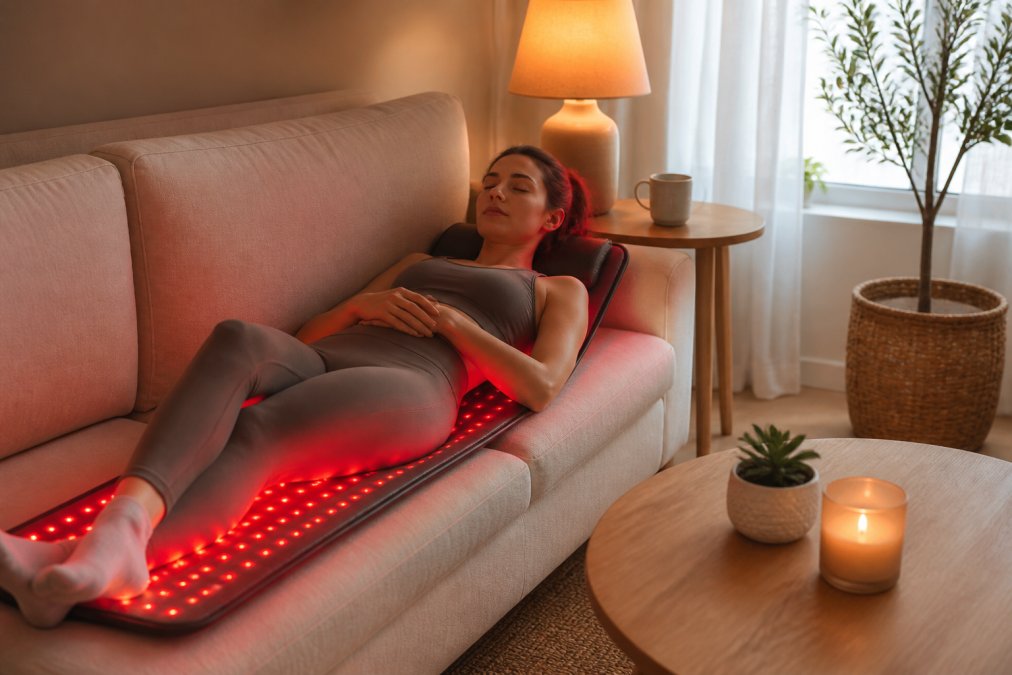
For full-body coverage at home, TresAdore offers a 1444 LED infrared physiotherapy mat that combines red and infrared wavelengths across a 180x80cm surface, plus a dual-wavelength therapy blanket with adjustable temperature control for targeted pain relief.


Frequently Asked Questions
What does Mayo Clinic say about red light therapy?
Mayo Clinic notes that red light therapy, also called photobiomodulation, shows promise for skin concerns and pain relief, though more large-scale studies are needed. It is generally considered safe when used as directed, but results vary by device and condition.
What is the downside of red light therapy?
The main downsides are the time commitment and inconsistent results if the device lacks proper irradiance or wavelength specifications. Some users experience mild redness or irritation. Without standardized dosing, outcomes can vary widely between devices.
Does red light therapy really work and why?
Research suggests it works by stimulating mitochondria to produce more ATP, which supports cellular repair and reduces inflammation. Studies show benefits for skin rejuvenation and pain, but effects depend on wavelength, dose, and treatment consistency.
What happens if you use red light therapy every day?
Daily use is generally safe for most people, but more isn't always better. Overuse may reduce results because the body needs recovery time. Following the device's recommended schedule, often 3-5 sessions per week, is usually enough to see benefits.
How does red light therapy interact with mitochondrial function?
Red and near-infrared light is absorbed by cytochrome c oxidase in mitochondria, which boosts ATP production and triggers cellular signaling. This can enhance tissue repair, reduce oxidative stress, and support overall cellular energy.
Is there a difference between red light and near-infrared light therapy?
Yes. Red light (around 660 nm) penetrates the skin's surface and is used for skin concerns like wrinkles and acne. Near-infrared light (around 850 nm) goes deeper into muscle and joint tissue, making it better for pain and recovery.
The science behind red light therapy is real, but results depend on choosing the right wavelength, dose, and device for your specific goal. TresAdore curates wellness technology alongside premium apparel, so you can find tools that fit your routine rather than fight it. Explore the collection to see which devices align with your skin and recovery goals.


